
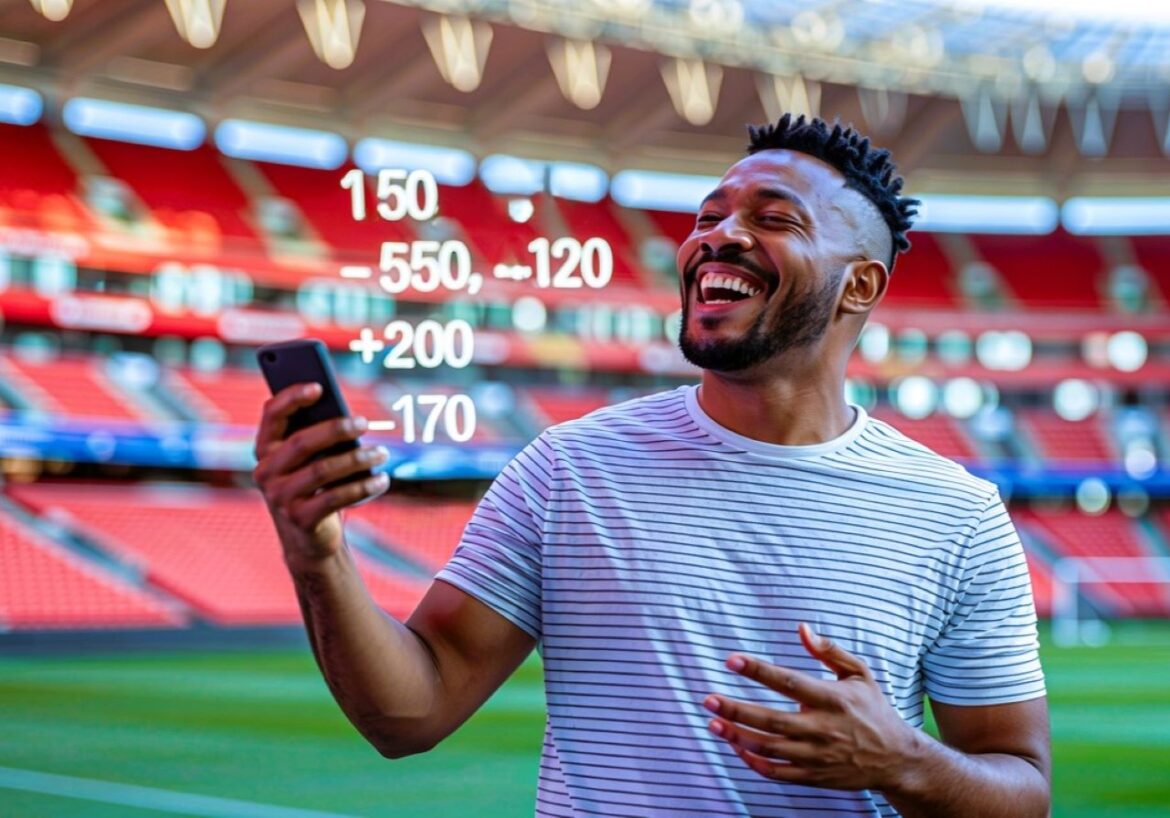
American odds, also known as moneyline odds or US odds format, represent the standard way sportsbooks display betting lines across the United States. These odds use a plus (+) and minus (–) system based on $100 increments to show both potential payouts and which team or outcome the sportsbook considers favored. For example, odds of -110 mean you need to risk $110 to win $100, while +150 odds mean a $100 bet would win $150 in profit.
This comprehensive guide provides the formulas, real-world examples, and step-by-step calculations you need to master American odds. While we’ll use $100 as our baseline for clarity, remember that all these formulas scale proportionally to any stake size—whether you’re betting $5 or $500, the ratios remain consistent.
What Are American Odds and Why the Plus and Minus Matter
American odds operate on a $100-based system where the plus and minus signs indicate whether you’re looking at a favorite or underdog. Minus odds (like -150) represent favorites and show how much you need to risk to win $100. Plus odds (like +200) represent underdogs and show how much profit you’d make on a $100 bet.
The beauty of this system lies in its scalability—once you understand the ratios, you can calculate payouts for any stake size. A -200 favorite paying 1:2 means every $2 risked wins $1, whether that’s $200 to win $100, $20 to win $10, or $6 to win $3.
These odds don’t just show potential payouts; they reflect the sportsbook’s assessment of probability and built-in profit margins. The larger the minus number, the stronger the favorite. The larger the plus number, the bigger the underdog with higher potential rewards.
Understanding this foundation helps you make informed betting decisions by quickly identifying favorites, underdogs, and the risk-reward profile of each wager before you even calculate specific payouts.
Favorites vs underdogs at a glance
- Negative odds (-110, -200, -500): Indicate favorites with higher win probability but lower payouts relative to risk
- Positive odds (+120, +300, +800): Signal underdogs offering higher payouts but lower win probability
- Payout relationship: Favorites require risking more to win less, while underdogs risk less to win more
- Probability correlation: Larger minus numbers mean stronger favorites, larger plus numbers mean bigger underdogs
- Risk-reward balance: Minus odds offer safer bets with smaller returns, plus odds provide higher variance with bigger potential profits
Why sportsbooks use American odds
Sportsbooks favor American odds because they clearly communicate both the favorite-underdog relationship and pricing structure in a single number. The system makes it easy for bettors to understand that -110 on a point spread includes the sportsbook’s built-in margin (vig or juice), requiring slightly more than even money to account for the house edge.
This format also allows sportsbooks to adjust lines efficiently while maintaining clear communication about shifting probabilities. When a line moves from -120 to -135, bettors immediately recognize the favorite strengthened and payouts decreased accordingly.
The $100 baseline provides a consistent reference point that scales naturally, making American odds particularly effective for recreational bettors who can easily visualize potential profits and required stakes across different bet sizes.
How to Read Minus American Odds (Favorites)
Minus odds tell you exactly how much you need to risk to win $100 in profit. The larger the minus number, the stronger the favorite and the more you must risk for the same $100 return. Understanding this inverse relationship is crucial—as favorites become more likely to win, your potential profits decrease.
These odds scale proportionally to any bet size. If -150 requires $150 to win $100, then $15 risks wins $10, $75 risks wins $50, and so forth. The ratio remains constant regardless of your actual stake.
Minus odds become more expensive as the number increases. Betting -300 means risking three times your potential profit, while -500 requires risking five times your potential return. This reflects the sportsbook’s confidence in the favorite’s chances.
| American odds (–) | Meaning in $100 terms | Profit on $100 stake | Total return on $100 stake | Typical use case |
|---|---|---|---|---|
| -110 | Risk $110 to win $100 | $90.91 | $190.91 | Standard spreads/totals |
| -150 | Risk $150 to win $100 | $66.67 | $166.67 | Moderate favorites |
| -200 | Risk $200 to win $100 | $50.00 | $150.00 | Strong moneyline favorites |
| -300 | Risk $300 to win $100 | $33.33 | $133.33 | Heavy favorites |
| -500 | Risk $500 to win $100 | $20.00 | $120.00 | Overwhelming favorites |
| -1000 | Risk $1000 to win $100 | $10.00 | $110.00 | Near-certain outcomes |
Formula for calculating payouts with minus odds
The formula for minus odds profit is: Profit = Stake × (100 ÷ |Odds|). The absolute value symbols (|Odds|) mean you ignore the minus sign in your calculation. For example, with $50 at -150 odds: Profit = $50 × (100 ÷ 150) = $50 × 0.667 = $33.35.
Your total return equals your original stake plus profit. Using the same example: Total Return = $50 stake + $33.35 profit = $83.35. This means risking $50 on -150 odds returns $83.35 total if you win.
This formula works for any stake size. Whether betting $5 or $500 on -150, you multiply your stake by 0.667 to find your profit. The ratio remains consistent, making calculations straightforward once you understand the basic formula.
How to Read Plus American Odds (Underdogs)
Plus odds show how much profit you’d make on a $100 stake, making them much simpler to read than minus odds. The number directly represents your potential profit: +150 means a $100 bet wins $150, +300 means $100 wins $300, and so forth.
These odds reflect higher risk but greater reward potential. Underdogs with plus odds typically have lower win probabilities, but successful bets deliver significantly larger payouts than favorites. The larger the plus number, the bigger the underdog and potential return.
Plus odds scale just as easily as minus odds. If +200 pays $200 profit on $100, then $50 wins $100, $25 wins $50, and $10 wins $20. The 2:1 profit ratio applies regardless of your actual bet size.
| American odds (+) | Meaning in $100 terms | Profit on $100 stake | Total return on $100 stake | Risk–reward profile |
|---|---|---|---|---|
| +110 | $100 stake wins $110 | $110 | $210 | Slight underdog |
| +150 | $100 stake wins $150 | $150 | $250 | Moderate underdog |
| +200 | $100 stake wins $200 | $200 | $300 | Strong underdog |
| +300 | $100 stake wins $300 | $300 | $400 | Heavy underdog |
| +500 | $100 stake wins $500 | $500 | $600 | Long-shot bet |
| +1000 | $100 stake wins $1000 | $1000 | $1100 | Extreme long shot |
Formula for calculating payouts with plus odds
Plus odds use a simpler formula: Profit = Stake × (Odds ÷ 100). For $30 at +300 odds: Profit = $30 × (300 ÷ 100) = $30 × 3 = $90. Your total return would be $30 stake + $90 profit = $120.
This straightforward calculation makes plus odds easier to work with mentally. +200 odds mean double your money, +300 means triple, +400 means quadruple, and so on. The math becomes intuitive once you recognize these ratios.
Unlike minus odds where larger numbers mean smaller returns, plus odds scale directly with the number. Higher plus odds always mean higher potential profits, making it easy to compare different underdog betting options at a glance.
Scaling American odds to any stake size
American odds represent ratios that work proportionally with any stake size. +200 odds create a 2:1 profit ratio, so $10 wins $20, $75 wins $150, or $5 wins $10. The relationship remains constant regardless of your actual bet amount.
For minus odds, the scaling works in reverse. -300 odds create a 1:3 ratio (risk $3 to win $1), so $30 wins $10, $150 wins $50, or $6 wins $2. Once you identify the underlying ratio, calculations become much simpler.
This proportional scaling allows you to quickly estimate payouts without complex calculations. Recognize that +150 is a 3:2 ratio, and you can instantly calculate that $20 wins $30, $40 wins $60, or any other stake size using simple multiplication.
Step-by-Step: Calculating Payouts from American Odds
Calculating American odds payouts follows a systematic process that works for any bet size. Once you master these steps, you can quickly determine potential profits and returns for any wager, whether dealing with favorites or underdogs.
The key difference lies in identifying whether you’re working with plus or minus odds, as each uses a different formula. However, the overall process remains the same: identify the odds type, apply the appropriate formula, and calculate your total return.
Comparing favorites versus underdogs demonstrates the risk-reward trade-off inherent in American odds. A -140 favorite requires more risk for smaller returns, while a +180 underdog offers larger profits with lower win probability.
- Identify the odds type: Check if the number has a plus (+) or minus (–) sign to determine favorite or underdog status
- Choose the correct formula: Use Stake × (100 ÷ |Odds|) for minus odds, or Stake × (Odds ÷ 100) for plus odds
- Calculate your profit: Plug your stake amount into the appropriate formula to determine winnings
- Add your stake back: Total return equals your original stake plus calculated profit
- Double-check the math: Verify your calculations make sense relative to the odds and stake size
Worked examples for real betting markets
Let’s calculate an $80 bet on -160 odds (favorite). Using the minus odds formula: Profit = $80 × (100 ÷ 160) = $80 × 0.625 = $50. Total return = $80 stake + $50 profit = $130. You risk $80 to potentially win $50 profit.
Now consider $50 on +210 odds (underdog). Using the plus odds formula: Profit = $50 × (210 ÷ 100) = $50 × 2.1 = $105. Total return = $50 stake + $105 profit = $155. You risk $50 to potentially win $105 profit.
These examples illustrate the fundamental difference in risk-reward profiles. The favorite bet risks more to win less ($80 to win $50), while the underdog bet risks less to win more ($50 to win $105). This relationship holds true across all American odds.
For larger stakes, the same principles apply. A $200 bet on -160 would profit $125 (total return $325), while $200 on +210 would profit $420 (total return $620). The ratios scale perfectly regardless of bet size.
Implied Probability: What American Odds Say About Chances
American odds contain embedded probability estimates that reveal what the sportsbook believes about each outcome’s likelihood. These implied probabilities help you assess whether odds offer good value by comparing the book’s assessment to your own analysis.
The formulas differ for plus and minus odds due to their different structures. For negative odds: Implied Probability = |Odds| ÷ (|Odds| + 100). For positive odds: Implied Probability = 100 ÷ (Odds + 100). These calculations reveal the break-even win rate needed for profitability.
Understanding implied probability transforms odds from simple payout calculations into strategic betting tools. When your estimated probability exceeds the implied probability, you’ve identified potential value bets with positive expected value over time.
| American odds | Type (+/–) | Implied probability formula | Implied probability % | Break-even win rate |
|---|---|---|---|---|
| -110 | Minus | 110 ÷ (110 + 100) | 52.38% | 52.38% |
| -150 | Minus | 150 ÷ (150 + 100) | 60.00% | 60.00% |
| -200 | Minus | 200 ÷ (200 + 100) | 66.67% | 66.67% |
| +120 | Plus | 100 ÷ (120 + 100) | 45.45% | 45.45% |
| +150 | Plus | 100 ÷ (150 + 100) | 40.00% | 40.00% |
| +200 | Plus | 100 ÷ (200 + 100) | 33.33% | 33.33% |
| +300 | Plus | 100 ÷ (300 + 100) | 25.00% | 25.00% |
Formulas for converting American odds to implied probability
Let’s work through a minus odds example with -120. Using the formula: Implied Probability = 120 ÷ (120 + 100) = 120 ÷ 220 = 0.5455 = 54.55%. This means the sportsbook believes this outcome has approximately a 55% chance of occurring.
For a plus odds example using +180: Implied Probability = 100 ÷ (180 + 100) = 100 ÷ 280 = 0.3571 = 35.71%. The sportsbook assesses this underdog as having roughly a 36% chance of winning.
These calculations reveal the inverse relationship between odds and probability. Stronger favorites (larger minus numbers) have higher implied probabilities, while bigger underdogs (larger plus numbers) have lower implied probabilities.
Using break-even percentages to judge your bets
Break-even percentages represent the minimum win rate needed for long-term profitability at given odds. If you believe an outcome has a higher probability than the break-even rate, you’ve identified a potentially profitable bet with positive expected value.
For example, if you estimate a team has a 70% chance to win but they’re priced at -150 (60% implied probability), the bet offers value. Your assessment exceeds the required break-even rate, suggesting long-term profitability if your analysis proves accurate.
This framework transforms betting from guessing into strategic analysis. Rather than simply picking winners, you’re comparing probabilities to identify situations where odds don’t accurately reflect true likelihood of outcomes.
Converting American Odds to Decimal and Fractional Formats
While American odds dominate US sportsbooks, understanding decimal and fractional equivalents helps when comparing odds across different platforms or international markets. Decimal odds show total return per dollar bet, while fractional odds display profit ratios in traditional fraction format.
Converting positive American odds to decimal: Decimal = (Odds ÷ 100) + 1. Converting negative American odds: Decimal = (100 ÷ |Odds|) + 1. For fractional odds from positive American odds: Fractional = Odds ÷ 100. From negative American odds: Fractional = 100 ÷ |Odds|.
These conversions maintain the same payouts and probabilities while presenting information in different formats. A +150 underdog, 2.50 decimal odds, and 3/2 fractional odds all represent identical betting propositions with different mathematical expressions.
| American odds | Decimal odds | Fractional odds | Notes |
|---|---|---|---|
| -110 | 1.91 | 10/11 | Standard spread/total odds |
| -150 | 1.67 | 2/3 | Moderate favorite |
| -200 | 1.50 | 1/2 | Strong favorite |
| +110 | 2.10 | 11/10 | Slight underdog |
| +150 | 2.50 | 3/2 | Moderate underdog |
| +200 | 3.00 | 2/1 | Strong underdog |
| +300 | 4.00 | 3/1 | Heavy underdog |
Worked conversion examples
Converting +150 American odds to decimal: Decimal = (150 ÷ 100) + 1 = 1.5 + 1 = 2.50. For fractional: 150 ÷ 100 = 3/2. All three formats (+150, 2.50, 3/2) represent the same bet where a $100 stake returns $250 total.
Converting -120 American odds to decimal: Decimal = (100 ÷ 120) + 1 = 0.833 + 1 = 1.833. For fractional: 100 ÷ 120 = 5/6. These formats (-120, 1.833, 5/6) all show that you need to risk more than you can win.
Converting +300 American odds: Decimal = (300 ÷ 100) + 1 = 4.00. Fractional = 300 ÷ 100 = 3/1. A $25 bet returns $100 total (including $75 profit) regardless of which format displays the odds.
Converting -300 American odds: Decimal = (100 ÷ 300) + 1 = 1.333. Fractional = 100 ÷ 300 = 1/3. You risk three units to win one unit, whether betting $300 to win $100 or $30 to win $10.
American Odds in Practice: Moneylines, Spreads and Totals
American odds appear across all major betting markets, with each presenting different applications and strategic considerations. Understanding how odds function in moneylines versus point spreads versus totals helps you identify the best betting opportunities and compare value across different bet types.
Moneylines use American odds to price each team’s outright win probability, creating different risk-reward profiles for favorites and underdogs. Point spreads typically feature -110 on both sides, focusing betting decisions on the line rather than odds differences.
Totals (over/under bets) also commonly use -110 pricing, though odds can shift based on betting action or injury news that affects expected scoring. Recognizing when odds deviate from standard -110 can signal value opportunities.
- Moneyline markets: Odds directly reflect win probability with favorites showing minus odds and underdogs showing plus odds
- Point spread betting: Standard -110 odds on both sides mean the line itself determines value, not odds differences
- Totals betting: Over/under typically priced at -110, with odds movement indicating sharp money or injury impact
- Alternate lines: Moving spreads or totals creates better or worse odds, allowing risk-reward customization
- Live betting odds: American odds update in real-time during games, creating dynamic value opportunities
Example moneyline board and what the odds tell you
Consider a typical NFL game with Team A at -145 and Team B at +125. The favorite (Team A) requires risking $145 to win $100, implying approximately 59% win probability. The underdog (Team B) returns $125 profit on a $100 bet, suggesting roughly 44% win probability.
The gap between these implied probabilities (59% + 44% = 103%) represents the sportsbook’s built-in margin or “vig.” Perfect efficient odds would total exactly 100%, but the 3% overage ensures the house maintains its edge regardless of the outcome.
Smart bettors analyze whether these implied probabilities accurately reflect each team’s true chances. If you believe Team B has better than 44% chance to win, the +125 odds offer positive expected value. If you think Team A wins less than 59% of the time, avoid the -145 price.
Line shopping between sportsbooks might reveal Team A at -140 elsewhere or Team B at +130, improving your risk-reward ratio. These small differences compound significantly over many bets, making odds comparison essential for serious bettors.
The role of -110 on spreads and totals
The standard -110 price on point spreads and totals creates a 52.38% break-even rate, meaning you must win more than 52.38% of bets to show long-term profit. This modest house edge makes spread and totals betting attractive for skilled handicappers who can identify value consistently.
When spreads move from -110 to -105 or -115, it signals significant betting action on one side. Books adjust odds before moving lines to balance action and manage risk. Sharp bettors monitor these movements to identify where professional money flows.
Occasional opportunities arise with -105 or even money pricing on spreads, reducing the break-even rate to 51.22% or 50%. These improved odds provide meaningful advantage over time, even though individual bet payouts change only slightly.
Beyond Singles: American Odds for Parlays and Multi-Leg Bets
Parlay betting combines multiple single bets into one wager, requiring all selections to win for payout. American odds don’t multiply directly in parlays—you must first convert each selection to decimal odds, multiply those decimal values, then convert back to determine combined payout odds.
This conversion process ensures accurate parlay calculations regardless of whether individual legs use plus or minus American odds. A two-leg parlay combining a -120 favorite with a +150 underdog creates different math than simply adding or subtracting the American odds numbers.
Parlays offer higher potential payouts but significantly lower win probability since all selections must hit. Understanding the true odds helps you evaluate whether parlay payouts justify the increased risk compared to betting legs individually.
Worked example: two-leg parlay with American odds
Let’s combine -120 and +150 into a two-leg parlay with a $100 stake. First, convert to decimal odds: -120 becomes 1.833, and +150 becomes 2.50. Multiply the decimals: 1.833 × 2.50 = 4.583 combined decimal odds.
With combined decimal odds of 4.583, a $100 parlay bet returns $458.30 total if both legs win. Your profit would be $358.30 ($458.30 total return minus $100 stake). Compare this to betting each leg separately for potentially different risk-reward outcomes.
The implied probability of this parlay succeeding equals the individual probabilities multiplied together. -120 implies 54.55% chance, +150 implies 40% chance. Combined: 54.55% × 40% = 21.82% parlay win probability. The 4.583 decimal odds imply 21.83% probability, confirming our calculation accuracy.
Individual leg betting offers more flexibility and potentially better overall returns, but parlays provide entertainment value and massive payout potential if you’re confident in multiple selections. Understanding the true math helps you make informed decisions about when parlays make sense.
Common Mistakes When Reading and Calculating American Odds
Many bettors make predictable errors when working with American odds, often leading to miscalculated payouts, poor bankroll management, or missed value opportunities. Recognizing these mistakes helps you avoid costly errors and improve your overall betting accuracy.
The most frequent errors involve confusing plus and minus calculations, using only $100 examples without scaling to actual bet sizes, and misunderstanding what implied probabilities represent. Each mistake can compound over time, turning potentially profitable betting into losing propositions.
Developing systematic approaches to odds calculation and double-checking your math prevents most common errors. Simple verification methods catch mistakes before they affect your bankroll or betting decisions.
- Formula confusion: Mixing up plus and minus formulas, leading to dramatically incorrect payout calculations
- Scaling errors: Only thinking in $100 increments instead of applying ratios to actual bet sizes
- Implied probability mistakes: Using wrong formulas for plus versus minus odds when calculating break-even rates
- Return vs profit confusion: Forgetting to add back stake when calculating total returns
- Parlay calculation errors: Trying to add American odds directly instead of converting to decimal first
Quick checklist before you place a bet
- Verify favorite vs underdog: Confirm minus sign means favorite, plus sign means underdog
- Double-check your formula: Use correct calculation for plus or minus odds
- Calculate implied probability: Ensure the break-even rate makes sense for your analysis
- Confirm total return: Add your stake back to profit for complete payout amount
- Scale check: Verify calculations work proportionally if you change bet size
When to use an odds calculator
Odds calculators prove invaluable for complex parlays, unusual American odds numbers, or when you want to verify manual calculations quickly. While understanding the underlying formulas remains important, calculators prevent arithmetic errors that can affect your betting decisions or bankroll management.
Use calculators for any parlay with three or more legs, odds conversions between formats, or implied probability calculations for large plus or minus numbers. However, always understand the manual process to double-check calculator results and catch potential input errors.
The best approach combines manual knowledge with calculator verification. Calculate simple odds manually to maintain your skills, but rely on calculators for complex scenarios where human error becomes more likely than computational mistakes.
Practical Tips for Using American Odds in Your Betting Strategy
Successful betting strategy goes beyond understanding odds calculations to implementing systematic approaches that maximize value and minimize risk. American odds provide crucial information for line shopping, bankroll management, and identifying profitable betting opportunities across different markets and timeframes.
Effective use of American odds involves comparing prices across multiple sportsbooks, tracking line movements to identify sharp money, and adjusting bet sizes based on perceived edge and implied probability differences. These strategic applications separate casual bettors from serious profit-seekers.
The key lies in treating American odds as tools for probability assessment rather than simple payout calculators. This mindset shift enables more sophisticated betting strategies that focus on long-term expected value rather than short-term results.
| Tactic | How it uses American odds | Benefit | Risk / trade-off |
|---|---|---|---|
| Line shopping | Compare -110 vs -105 across books | Lower break-even rates, higher long-term profits | Requires multiple accounts, time investment |
| Value betting | Find implied probability gaps | Positive expected value over time | Requires accurate probability estimation |
| Bankroll scaling | Adjust stakes based on implied edge | Optimize risk-reward ratios | Requires discipline, variance tolerance |
| Steam chasing | Follow sharp money line moves | Leverage professional insights | Lines move quickly, reduced odds available |
| Hedge betting | Calculate guaranteed profit scenarios | Lock in profits, reduce risk | Lower maximum profits, complexity |
Bankroll management and price sensitivity
- Kelly Criterion application: Use implied probability differences to calculate optimal bet sizes for maximum growth
- Price shopping impact: Getting -105 instead of -110 reduces break-even rate by nearly 1%, significant over many bets
- Variance considerations: Plus odds create higher variance, requiring larger bankrolls to withstand losing streaks
- Unit sizing strategy: Scale bet sizes based on confidence level and implied edge, not just gut feelings
- Break-even tracking: Monitor your actual win rate against required break-even rates for each odds range you bet